Bigger day out · Los Angeles
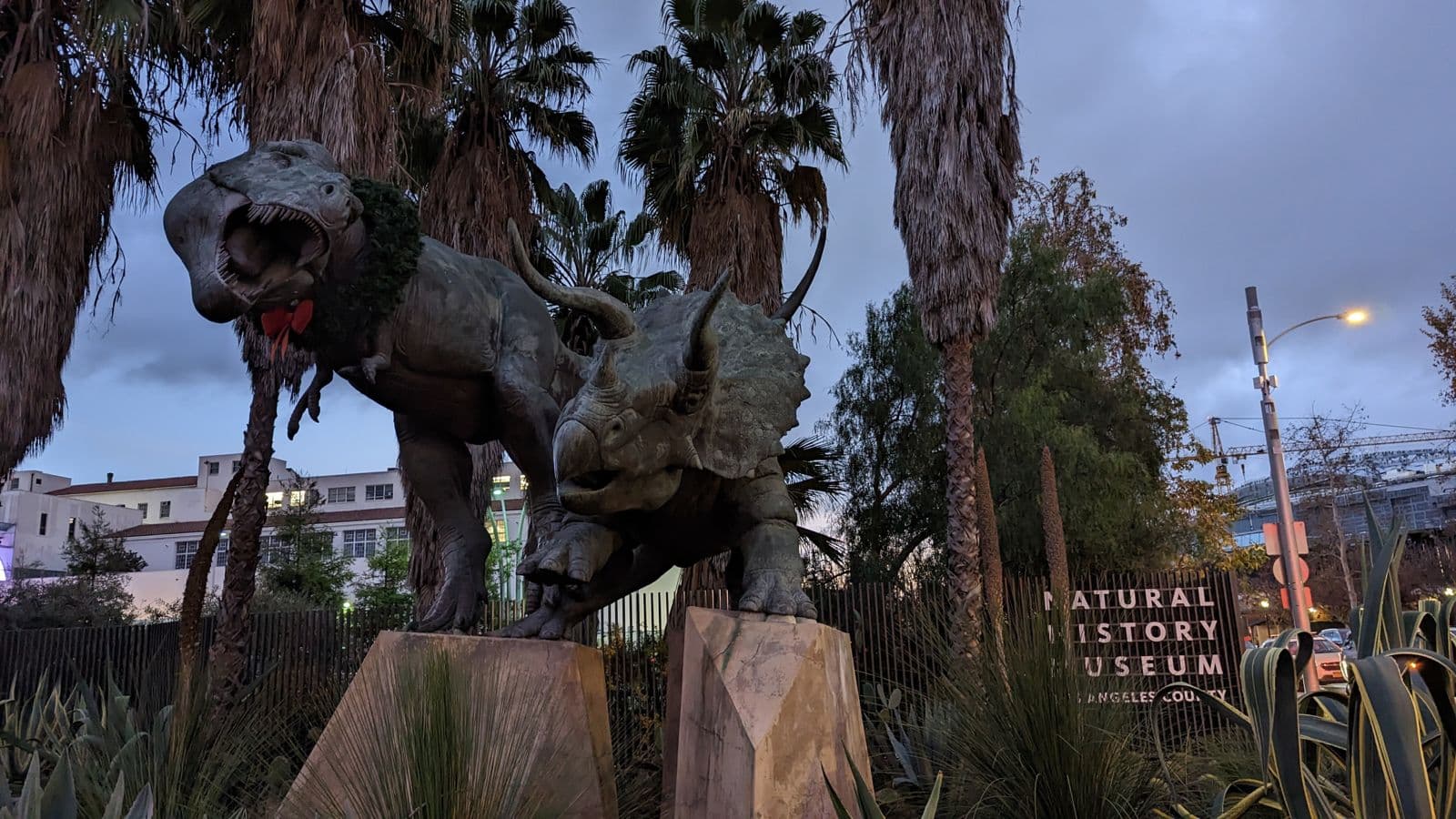
Natural History Museum of Los Angeles County
Dinosaur hall, gem vault and gardens in Exposition Park.
The story
The Natural History Museum of Los Angeles County sits in Exposition Park, right beside the California Science Center.3 It is part of the Natural History Museums of Los Angeles County, a family that also includes the museum at the La Brea Tar Pits in Hancock Park.1,3 Step inside and you are walking through 4.5 billion years of history, from dinosaurs to gems and minerals.1,3
The collection holds nearly 35 million specimens and artifacts, including vast research collections kept both on and off site.3 The museum says it offers something for everyone, with topics that range from birds and oceans to the story of Los Angeles itself.1
History
The idea began in the 1890s with William Miller Bowen, an attorney and Sunday school teacher who hoped to turn Agricultural Park into a cultural center.3 Ground was broken for a historical and arts museum in July 1910, and later that year the park was renamed Exposition Park.3 In November 1913, the Los Angeles County Museum of History, Science, and Art first welcomed visitors, drawing a crowd of over one thousand guests to its inaugural reception.3
The museum helped host the 1932 Summer Olympics, holding over 1,100 artworks from thirty-one countries for the artistic competitions.3 In 1963 the Los Angeles County Museum of Art was established as a separate museum in Hancock Park.3 After that split, the original facility became known as the Natural History Museum of Los Angeles County.3
The 1913 Building reopened in 2009 after two years of renovation, with original features like a stained glass skylight restored and a seismic retrofit added.3 Dinosaur Hall followed in 2011 and Becoming Los Angeles in 2013, along with a new glass entrance pavilion and an urban wilderness.3 In 2024 the museum completed NHM Commons, an addition with a cafe, a theater and a mounted sauropod skeleton.3
What to see and do
Start with the permanent halls, then let the special exhibitions pull you deeper.1,3 - **Dinosaur Hall:** The New York Times found that this hall does well at showing how paleontologists built our understanding of the prehistoric world.3 - **Age of Mammals:** The first exhibition in the restored 1913 Building spans more than 65 million years and ends with a warning about modern climate change.3 - **Becoming Los Angeles:** This exhibit traces the city's history, divided into the years before and after 1929.3 - **Nature Lab:** This exhibition explores urban wildlife in Southern California.3 - **Ralph M Parsons Discovery Center and Insect Zoo:** Wikipedia lists this among the museum's popular permanent displays.3 - **Gems and minerals:** Wikipedia counts mineralogy among the museum's most esteemed collections, and the museum holds Kyawthuite, a rare gemstone.3 - **Special exhibitions and pavilions:** Rotating shows appear alongside an outdoor butterfly pavilion and a spider pavilion on the same site.1,3
Why it matters
According to Wikipedia, this is the biggest museum of natural history and history in the western part of the United States, holding close to 35 million artifacts and specimens.3 The two museums in the family share a mission of sparking wonder and discovery, along with a sense of responsibility for the natural and cultural world.3 Beyond the galleries, the museum maintains research collections in fields from anthropology to vertebrate paleontology.3 Its historical documents are kept in the Seaver Center for Western History Research.3 Visitors can also explore a dedicated display on P-22, the mountain lion who once roamed close-by Griffith Park, which the museum has offered since 2017.3
Getting there
The museum is at 900 Exposition Blvd in Los Angeles, inside Exposition Park next to the California Science Center.1,3 From the San Gabriel Valley, head into the city toward Exposition Park, and check the official site for directions and visiting details.1
Sources
Written by TravelHere from the sources below (draft deepseek/deepseek-v4.1-flash, polish z-ai/glm-5.3, final anthropic/claude-opus-5.5).
- 1. Natural History Museum of Los Angeles County: Natural History Museum of Los Angeles County (opens in a new tab) (retrieved 2026-10-16)
- 3. Wikipedia: Natural History Museum of Los Angeles County (opens in a new tab) (retrieved 2026-10-16)