Bigger day out · Los Angeles
LACMA
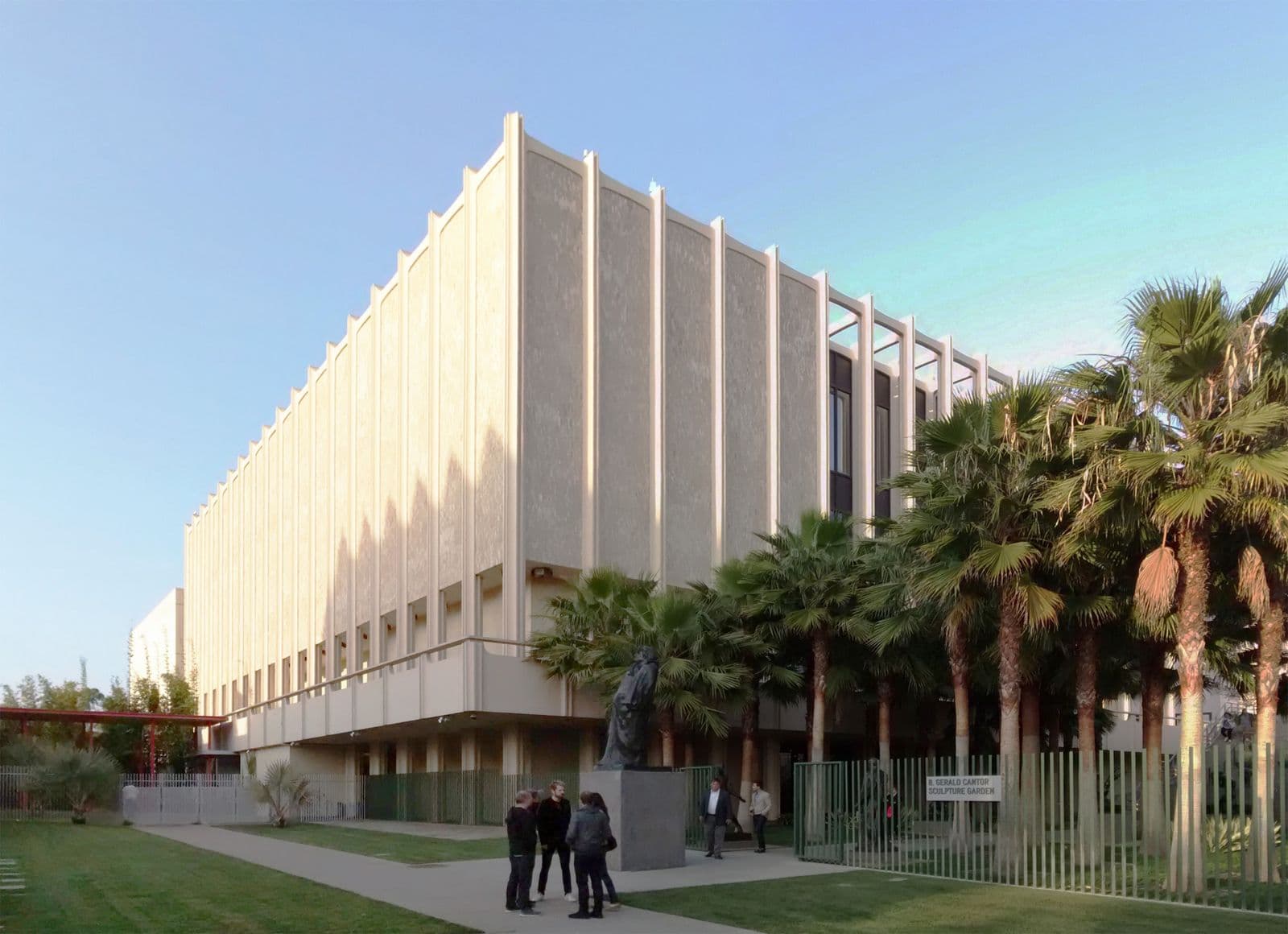
The Los Angeles County Museum of Art, with the Urban Light lampposts out front.
The story
LACMA sits on Wilshire Boulevard within a corridor of cultural institutions that includes the La Brea Tar Pits and the Academy Museum of Motion Pictures.2,4 The museum describes itself as the largest art museum in the western United States, and its collection of 155,000 objects spans 6,000 years of art from around the world.2 Wikipedia describes it the same way, adding that it draws nearly a million visitors each year.4
A visit can be as long or as loose as you like: wander the galleries, catch a film or a concert, and step outside to the tar pits next door.4 The newest chapter is the David Geffen Galleries, which opened in 2026 and gathers art from every corner of the collection onto a single level.2
History
Founded in 1910 within Exposition Park, the Los Angeles County institution devoted to history, science, and art is where LACMA got its start, and in 1961 the art side split off to become its own standalone museum.2 Wikipedia gives the founding year of the earlier museum as 1913 and places it near the University of Southern California.4 In 1965 the museum welcomed the public to its new Wilshire Boulevard location, where the Ahmanson Building held the permanent collection and the Hammer Building hosted special exhibitions.2
The Anderson Building, later renamed the Art of the Americas building, opened in 1986 for modern and contemporary art, and the Bruce Goff-designed Pavilion for Japanese Art followed in 1988.2 The museum purchased a onetime department store at the corner of Wilshire and Fairfax in 1994, and that structure now houses the Academy Museum of Motion Pictures.2
Since 2007, LACMA reports that it has doubled its exhibition program, its audience and its campus, and it has run a gallery at Charles White Elementary School in MacArthur Park.2 Two Renzo Piano-designed additions, the Broad Contemporary Art Museum and the Lynda and Stewart Resnick Exhibition Pavilion, arrived along the way.2 Then, in 2026, came the new home for the permanent collection, the David Geffen Galleries, designed by Pritzker Prize-winning architect Peter Zumthor.2
What to see and do
The collection ranges across cultures and centuries, and the museum's own programs invite you to take it in at your own pace.1,2
The David Geffen Galleries
The new building for the permanent collection puts the museum's global holdings all on one level, so no single culture or era outranks another.2
Rotating exhibitions
The galleries host a rotating series of shows rather than one fixed presentation, offering many routes through the collection.2
Docent tours
Guided tours cover subjects ranging from a full exhibition to a single artwork.1
Self-guided tours for students
The museum offers downloadable activity sheets for self-guided school visits through the collection.1
Jazz and talks
LACMA's calendar includes live jazz performances as well as talks and artist walkthroughs.1
The LACMA Store
The shop carries museum-developed catalogues and publications, plus books, posters and more.1
Cafe
The museum's on-site cafe serves organic coffee and matcha, pastries, smoothies, cold-pressed juices and grab-and-go meals.1
Why it matters
LACMA's mission is to serve the public by collecting, conserving, exhibiting and interpreting significant works from many cultures and eras, and by turning those collections into meaningful experiences for the widest possible audiences.2 The museum commits to presenting art histories through fresh points of view shaped by the region's cultural heritage and diverse population.2 It also acknowledges that its land was originally, and still is, cared for by the Tongva, Tataviam, Serrano, Kizh and Chumash Peoples.2 For a visitor from the San Gabriel Valley, it is a place to stand in front of objects made across six millennia.2
Getting there
LACMA sits at 5905 Wilshire Boulevard in Los Angeles, on Museum Row in the Miracle Mile area, beside the La Brea Tar Pits.1,4 Along Wilshire, it sits within a renewed stretch of cultural venues, joining the Academy Museum of Motion Pictures, the Petersen Automotive Museum, the tar pits and the Craft and Folk Art Museum.2
Sources
Written by TravelHere from the sources below (draft deepseek/deepseek-v4.1-flash, polish z-ai/glm-5.3, final anthropic/claude-opus-5.5).
- 1. LACMA: LACMA (opens in a new tab) (retrieved 2026-10-16)
- 2. LACMA: LACMA (opens in a new tab) (retrieved 2026-10-16)
- 4. Wikipedia: Los Angeles County Museum of Art (opens in a new tab) (retrieved 2026-10-16)