
Aloha Food Factory
Eat · Alhambra
Text or call (855) 212-4853
Koli from TravelHere replies by text. Msg & data rates may apply. Reply STOP to opt out, HELP for help.
Bigger day out · Los Angeles
Home of the Los Angeles Dodgers since 1962.
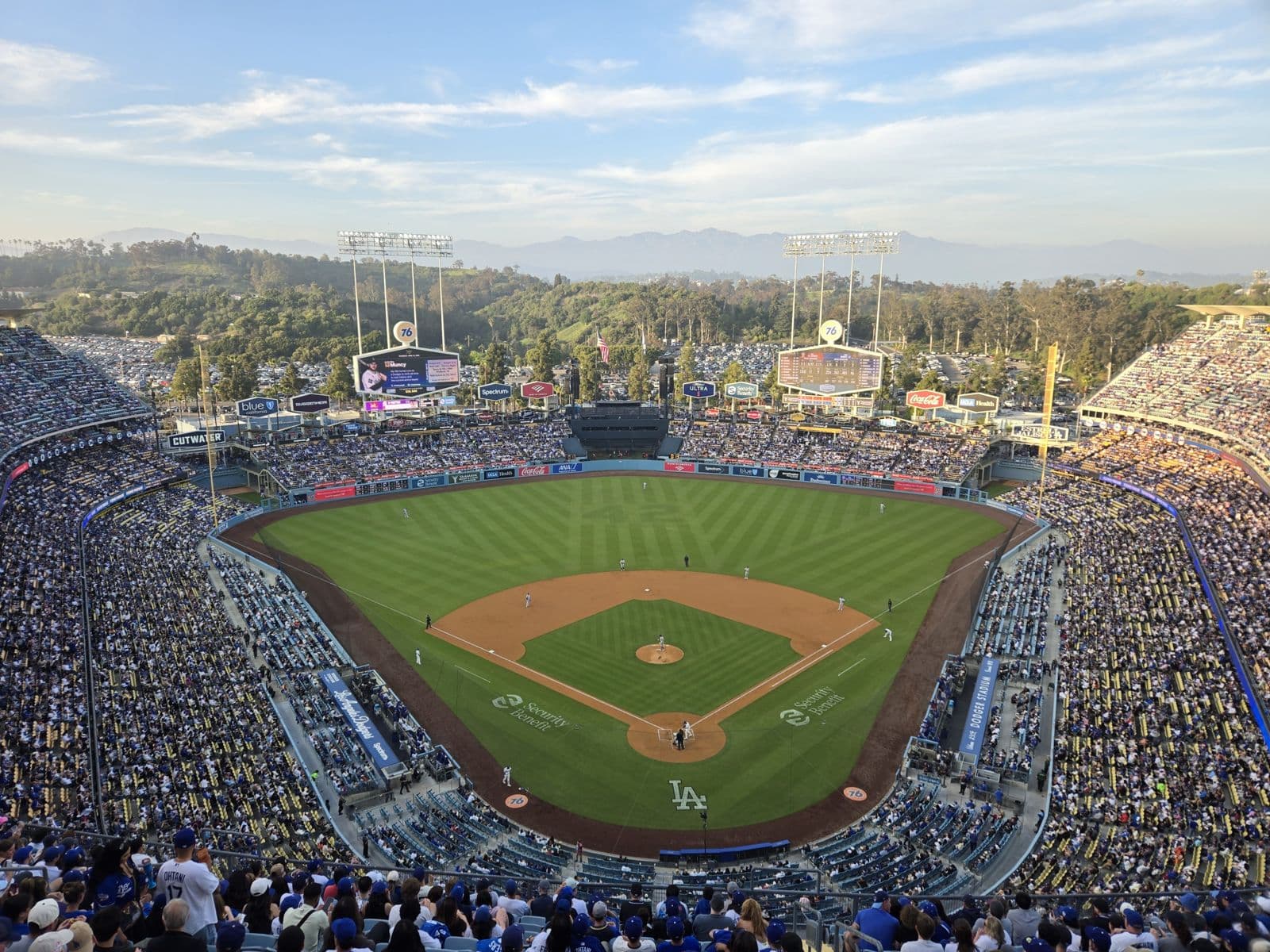
Located in Los Angeles's Elysian Park area, Dodger Stadium serves as the home ballpark for the Major League Baseball team known as the Los Angeles Dodgers.2 The ballpark opened in 1962, and it was built in under three years.2
The stadium is commonly called Chavez Ravine Stadium, after the landform it occupies.2 A former Dodgers manager, Tommy Lasorda, gave it the nickname Blue Heaven on Earth.2 Known as a pitcher's ballpark, the stadium has seen 13 no-hitters, two of them perfect games.2
In the mid-1950s, Walter O'Malley, then president of the Brooklyn Dodgers, hoped to build a domed stadium in Brooklyn, but he and city officials never agreed on the land.2 He eventually struck a deal with the city of Los Angeles.2 The city had earlier taken the stadium land from local owners and residents through eminent domain, paid for by the federal Housing Act of 1949.2
The city had planned the Elysian Park Heights public housing project on that land, with two dozen buildings of 13 stories plus more than 160 townhouses.2 After Norris Poulson was elected mayor of Los Angeles in 1953, support for such projects faded.2 On June 3, 1958, Los Angeles voters approved a referendum that let the Dodgers acquire 352 acres of Chavez Ravine from the city.2 Residents, mainly Hispanics, were forcefully evicted.2
Ground was broken for Dodger Stadium on September 17, 1959.2 Crews cut away the tops of nearby ridges and used that soil to fill Sulfur and Cemetery Ravines, creating level ground.2 Eight million cubic yards of earth were moved, and 21,000 precast concrete units were fabricated onsite.2
The ballpark has a number of features worth seeking out.2
Outfield pavilion roofs
The wavy roofs atop each outfield pavilion are among the stadium's most distinctive features.2
The elevator shaft
A 10-story elevator shaft bearing the Dodger logo rises directly behind home plate at the top seating level.2
Center field plaza
A renovation added a 2-acre center field plaza with a children's playground between the left field and right field bleachers.2
Jackie Robinson statue
The Jackie Robinson statue was relocated from the left field entrance to the center field playground.2
Sandy Koufax statue
A statue of Sandy Koufax was commissioned to stand next to the Robinson statue.2
Terraced parking
A terraced-earthworks parking lot behind the main stands lets ticket-holders park near the level of their seats.2
Strobe lights
Strobe lights flash when the Dodgers take the field, after a home run, and after a win.2
Dodger Stadium is the oldest ballpark in Major League Baseball west of the Mississippi River, and the third-oldest overall, after Fenway Park in Boston and Wrigley Field in Chicago, according to Wikipedia.2 Wikipedia also describes it as the largest baseball stadium in the world by seat capacity.2 It hosted the All-Star Game in 1980 and 2022, and the World Series twelve times.2 The venue was also the stage for the final rounds, both semifinals and championship games, of the World Baseball Classic in 2009 and again in 2017.2 According to Wikipedia, it was the first Major League Baseball stadium built with 100 percent private financing since the original Yankee Stadium, and the last until Oracle Park opened in 2000.2
Dodger Stadium is in the Elysian Park neighborhood of Los Angeles, near the convergence of several freeways close to downtown.2 The official Dodgers site covers getting to the stadium, so check it for directions and visiting details.1
Written by TravelHere from the sources below (draft deepseek/deepseek-v4.1-flash, polish z-ai/glm-5.3, final anthropic/claude-opus-5.5).
Eat · Alhambra
Eat · Alhambra
Eat · Alhambra
Do · Alhambra